
Credibility Inspector
The Credibility Inspector
Section titled “The Credibility Inspector”The Credibility Inspector is the usability layer over the UofA toolchain. It is live at uofa.net/demo, backed by a HuggingFace Space, and it runs the same code the command line runs.
Its design claim is narrow and testable: a practitioner can produce and read a Unit of Assurance without learning what one is. No RDF, no SHACL, no JSON-LD, no signatures, no vocabulary. Upload evidence, confirm what the tool understood, read the result.
This document states that claim, shows the flow that implements it, marks exactly where human judgment enters, and records what has and has not been demonstrated.
1. What the claim means
Section titled “1. What the claim means”“Hidden complexity” is easy to assert and easy to fake, so it is worth fixing what would falsify it.
The Inspector satisfies the claim if a user completing an assessment is never required to:
- know that the artifact is a graph, or that the graph is RDF;
- read or write any vocabulary term (
hasCredibilityFactor,factorStatus); - understand SHACL, the rule engine, or what a weakener is, in order to act on one;
- handle a key, a hash, or a signature to obtain a verifiable package.
And it fails if any of those leak into the flow.
The user’s total obligation is one thing: confirm or correct the credibility factor statuses the tool read. Everything else — routing to a standard, mapping to a graph, structural validation, rule evaluation, signing — happens without being surfaced as a task.
The corresponding cost is stated in §6, and the limits in §7. The claim is about the interface, not about the extraction being correct.
2. The flow
Section titled “2. The flow”Four steps. Each figure is captured from the deployed Space by
dev/tools/scripts/capture_inspector_screenshots.py, which drives the real
pipeline against the bundled public sample, so the figures can be regenerated
after any change rather than maintained by hand.
Step 1 — Start
Section titled “Step 1 — Start”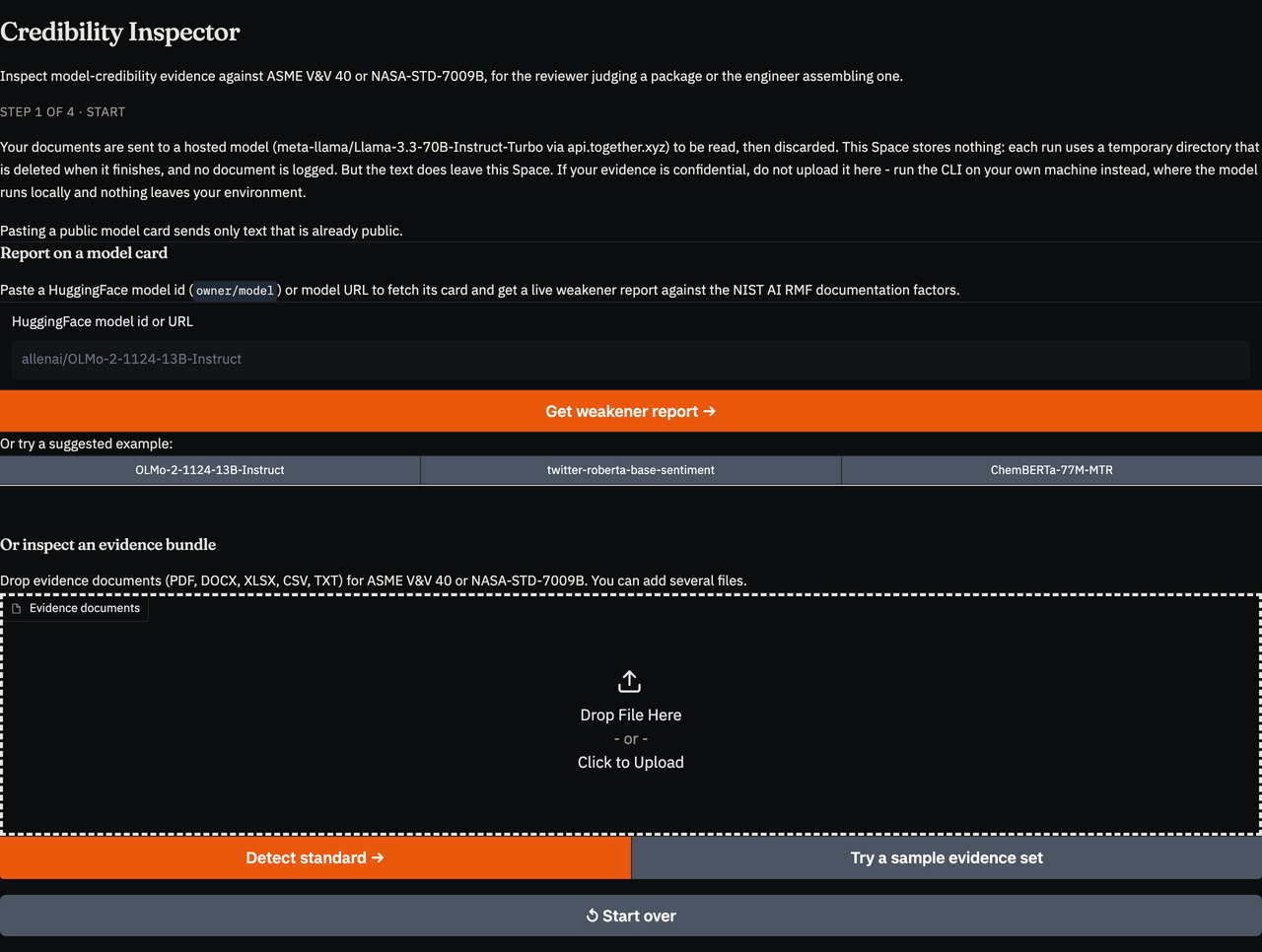
The user supplies evidence, or a public model card identifier, or takes the bundled sample. The disclosure about where documents are processed sits above the file picker rather than below it, because a disclosure a user meets after uploading is not a disclosure (§6).
Step 2 — Confirm the standard
Section titled “Step 2 — Confirm the standard”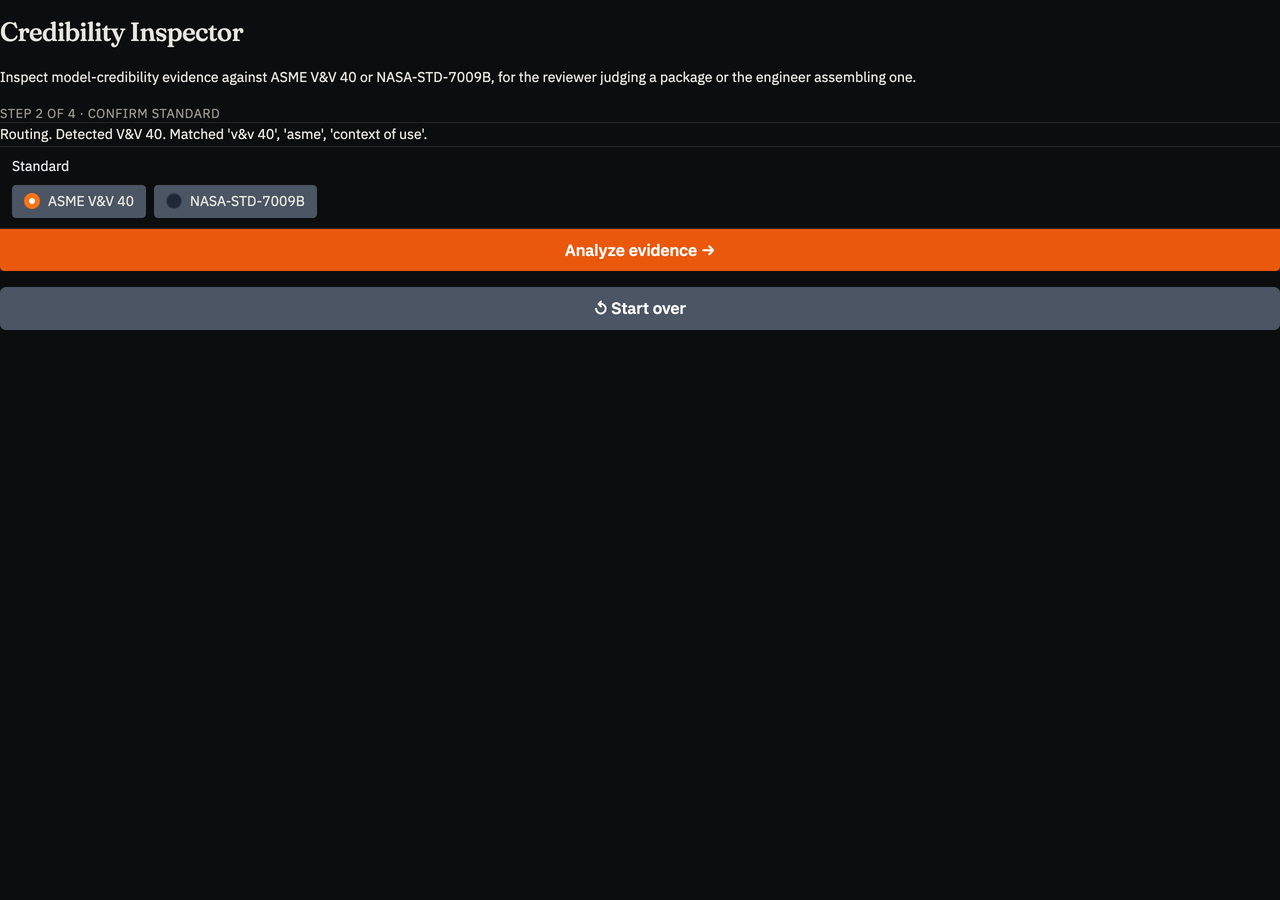
A keyword router reads the corpus and proposes a standard (ASME V&V 40 or NASA-STD-7009B), showing its reasoning. The user can override it.
When the routing signal is weak the tool refuses to auto-advance: the button is disabled until the user chooses explicitly. A confident guess on thin evidence would be the same failure the whole project is about.
Step 3 — Confirm what the tool understood
Section titled “Step 3 — Confirm what the tool understood”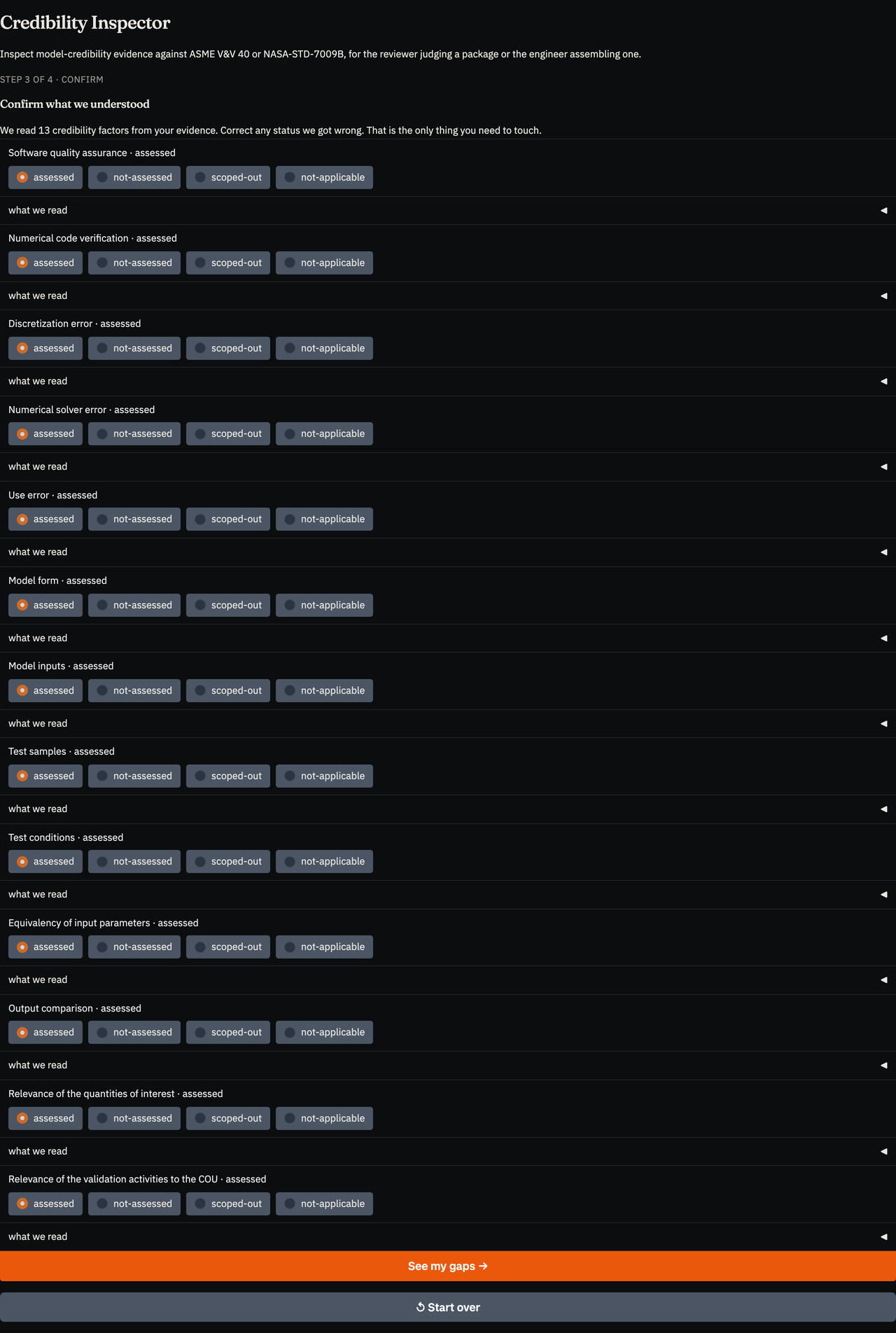
The tool presents every credibility factor it read, with the status it assigned and a “what we read” panel giving the plain-language gloss and the rationale it extracted. The user corrects anything wrong.
This is the only editable surface in the flow, and it is the subject of §3.
Step 4 — Read the result
Section titled “Step 4 — Read the result”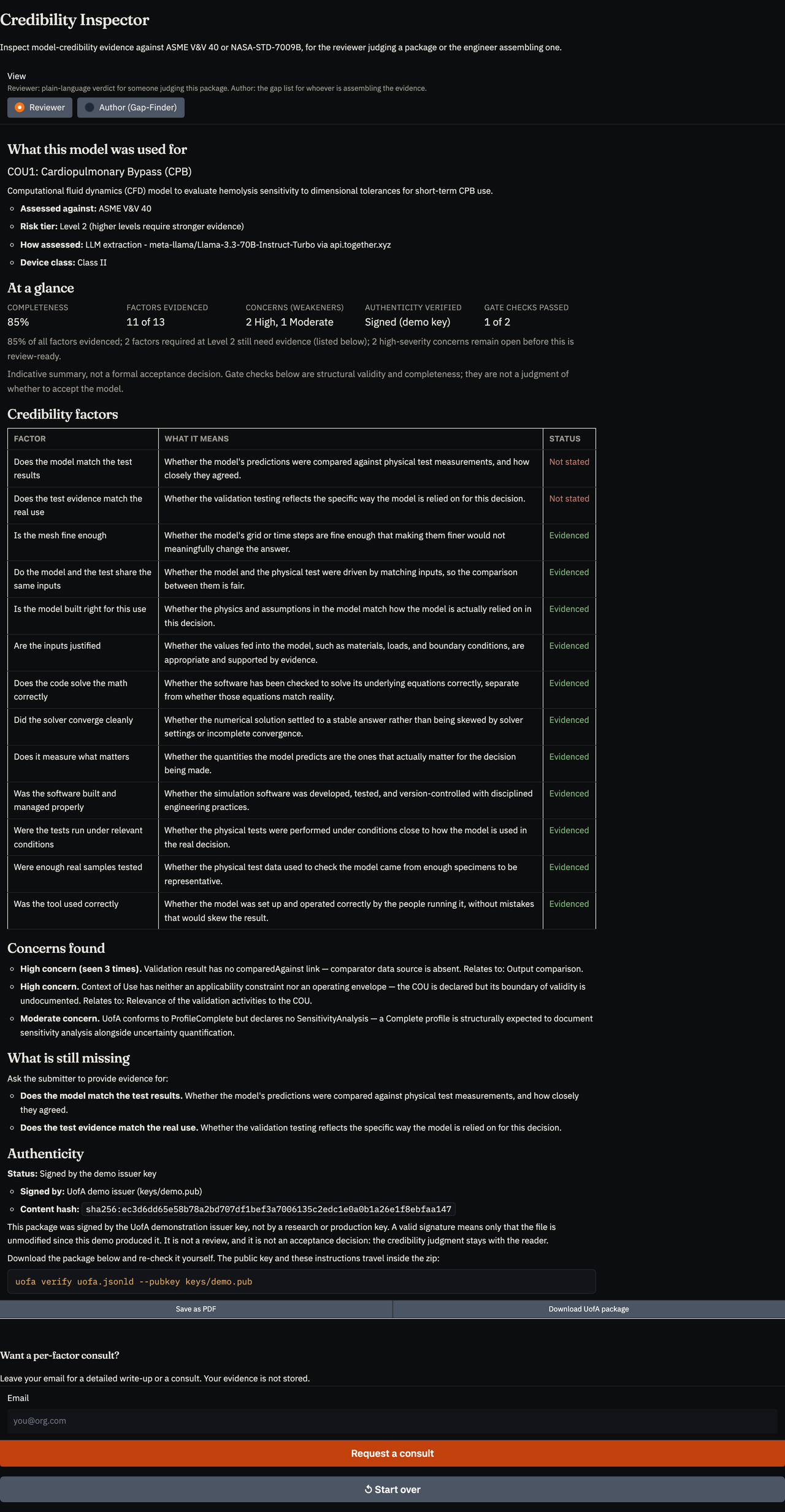
One analysis, two readings (§4), plus the downloadable package (§5).
3. Human adjudication role
Section titled “3. Human adjudication role”This section supports the human-adjudication disclosure (must-have 5).
All adjudication in this work was performed by the author. The programme’s no-external-contributor constraint precludes independent reviewers, and that is a limitation of the study rather than a design choice. The mitigations are the published adjudication protocol, the label-class partition that confines author judgment to the JUDGMENT class, and the self-consistency study.
The Inspector contributes something those mitigations cannot: a place to point. Step 3 is the adjudication step, and it is:
- Bounded. Factor status is the only user-mutable field. The user cannot edit rationales, levels, entities, validation results, or the decision record. Whatever the human contributes to the result, it contributed there.
- Visible. The step is not a hidden review pass. It occupies a numbered step of a four-step flow and cannot be skipped.
- Identical to the study workflow. The Space calls the same functions as the command line. There is no demo-only adjudication path.
- Recorded. Each factor in the emitted package carries a
statusProvenancevalue saying whether the status is the model’s or the human’s.
That last property was added because the disclosure was otherwise unfalsifiable from the artifact. Before it, a human correction silently replaced the extracted value, and a reader holding a downloaded package could not tell which statuses the model produced and which a person changed. The claim “judgment is bounded to step 3” was true of the software and unverifiable from its output.
Two classes, not three
Section titled “Two classes, not three”statusProvenance records extracted or corrected. It deliberately does not
record confirmed.
The interface pre-fills every status from the extraction and the user submits the
form. An unchanged factor is therefore one the user may have read and agreed
with, or may have scrolled past. Recording that as confirmed would assert an
act of judgment the interaction does not evidence. extracted claims only what
is true: the model produced this value and no human moved it.
This matters for reading any adjudicated figure. “13 of 13 confirmed” would suggest thirteen judgments; what actually occurred may be one judgment about the set. The artifact should not inflate that, and does not.
The field is emitted only where a confirmation step actually ran. A package built from a spreadsheet cannot know which cells a human touched, and there the honest answer is silence rather than a guess — the same rule the package already applies to its other provenance classes.
4. One analysis, two readings
Section titled “4. One analysis, two readings”The same analysis is rendered two ways: a Reviewer view for someone deciding whether to trust a finished package, and an Author (Gap-Finder) view for whoever is assembling the evidence.
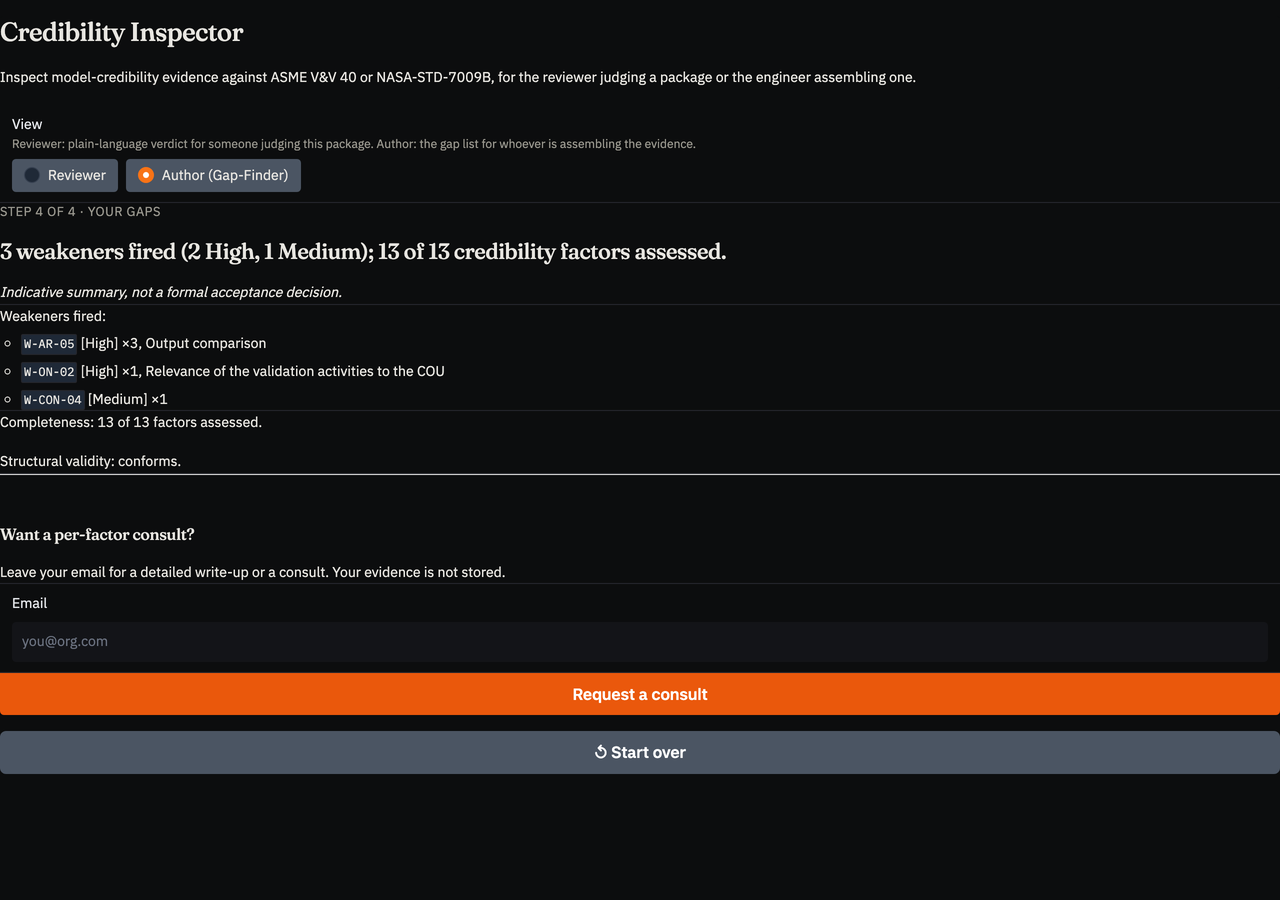
The toggle switches presentation only. It runs nothing and recomputes nothing.
This is enforced rather than intended. Both views derive from a single state
object built once, with invariants asserted at construction. The discipline
exists because an earlier build rendered contradictory verdicts for the same
package across the two views — the reviewer summary and the author gap list
disagreed about whether the same COU was adequately evidenced. Deriving twice
from one payload is enough to permit that; the protocol is documented in
docs/reviewer-render-protocol-spec.md.
The readout also declines to issue a verdict. It reports completeness, gaps and weakener concerns, and states explicitly that it is indicative rather than a formal acceptance decision. Acceptance is a human decision, and the tool does not have the standing to make it.
5. The package
Section titled “5. The package”“Download UofA package” emits the assurance package itself, not only a report.
The zip contains the signed JSON-LD graph with its provenance, a rendered report, a manifest, the public key, and verification instructions. The graph is the artifact; everything else is a convenience copy. A recipient checks it with:
unzip uofa-pack-*.zipuofa verify uofa.jsonld --pubkey keys/demo-reviewer.pubIt is built by the same code path as the command line’s uofa import, and a
package produced by the web flow is accepted by the CLI verifier. That property
is enforced by a test that drives one input through both paths and fails if the
resulting digests diverge, so the web path cannot quietly become a fork.
What a signature here does and does not mean
Section titled “What a signature here does and does not mean”The demo signs with a demonstration issuer key, not a research or production
key, and deliberately not the default trust anchor: --pubkey is required. A
package from the demo therefore cannot be mistaken for a formally issued one.
A valid signature means the file is unmodified since the demo produced it. It is not a review and not an acceptance decision. The readout says so in the same panel that displays the signature, because a green “verified” badge beside a content hash invites exactly the inference the project exists to discourage.
The public key travels inside the zip so verification works offline. A trust
anchor shipped inside the artifact it validates proves only self-consistency, so
its fingerprint is published independently in space/README.md and on the site.
Implementation notes, including the hash-stability constraint that governs
package verification, are recorded with the code rather than here: see
tests/test_context_pin.py and space/DEPLOY.md.
6. What usability cost
Section titled “6. What usability cost”Extraction runs on a hosted model. The Space carries no local model, and that buys the responsiveness the flow depends on — an analysis completes in seconds rather than minutes — at a price that has to be stated rather than absorbed.
Documents uploaded to the demo are sent to a third party to be read. The Space itself stores nothing: each run uses a temporary directory deleted when it finishes, and no document is logged. But the text leaves the Space, and the provider’s terms govern what happens to it there. Suppressing our own logging says nothing about theirs.
This is disclosed before upload, not after, and the readout names the extractor that read the evidence so the disclosure survives into the artifact rather than living only on the page.
The privacy-preserving configuration is the command line, and it is not a downgrade. The CLI accepts any OpenAI-compatible endpoint, so the same model can be served from a private deployment:
uofa extract ./evidence --pack vv40 \ --extract-backend openai-compatible \ --extract-base-url http://localhost:8000/v1 \ --extract-model meta-llama/Llama-3.3-70B-InstructNothing leaves the operator’s environment, and the extraction path is identical
to the demo’s. A smaller local model runs the same way through the ollama
backend. See docs/llm-config.md.
The demo is a demonstration artifact. Anyone assessing confidential evidence should run the CLI.
7. Limits
Section titled “7. Limits”The detection score does not measure extraction quality, and we can show it
Section titled “The detection score does not measure extraction quality, and we can show it”Scored against a corpus of synthetic assessment bundles (30 development + 20
held-out), raw extraction by meta-llama/Llama-3.3-70B-Instruct-Turbo gives —
no adjudication step, meaning no human corrected a factor status between
extraction and scoring, so these are the model’s unaided numbers rather than the
practical ceiling a user with the confirm step would reach:
| split | bundles | mean overall F1 | null control | groundedness (coverage / claim density / grounded) |
|---|---|---|---|---|
| held-out test | 20 | 0.9544 | 0.9544 | 1.000 / 0.216 / 1.000 |
| development | 30 | 0.9637 | 0.9637 | 1.000 / 0.188 / 0.982 |
The null control is control_constant_list: emit the pack’s fixed checklist of
factor names, having read no input at all. It ties the extractor to four decimal
places on both splits. This metric cannot distinguish reading the document
from not reading it, so it can neither support nor refute a claim about
extraction quality, and it is reported here to gate nothing.
Earlier revisions of this page gave 0.8909 and 0.9035 for these splits without the control beside them, and described the held-out figure as clearing its threshold. Both numbers were real and both were misleading, in two ways worth stating plainly:
- They sat below their null controls (0.9544 and 0.9637), which was not disclosed because the controls were not reported.
- On the NASA half of each corpus they were measuring a routing bug, not
extraction.
uofa extract --pack nasa-7009bwas sending the model the ASME V&V 40 prompt, so six of the nineteen NASA factors were never asked about and scored 0.000 each. Fixed; the NASA half moves 0.8385 to 0.9588 on dev and 0.8167 to 0.9436 on test, and the V&V 40 half does not move at all. Seestudies/nasa-prompt-routing/FINDINGS.md.
Both figures stay on this page. The pairing — a score, beside a control that equals it — is the disclosure, not a footnote to it.
Groundedness is given as the triple and should be read as one. At a claim density of 0.19–0.22, “groundedness 1.000” describes about a fifth of the output, and it is close to tautological for an extractor that mostly quotes.
That is not a hypothetical caution. The migration to hosted inference cut the
corpus’s checkable claims from 864 to 200 while coverage rose to 1.000 and
groundedness held at 0.99. Two of the three numbers moved the reassuring way
while three quarters of the verifiable content disappeared. Reported alone,
either one would have described that as an improvement. The same run shows
acceptance_criteria distinctness across documents falling from 0.937 to 0.443
— the model writes one generic criterion per factor and reuses it everywhere,
which within-bundle counts cannot see. Both are open questions with declared
thresholds in studies/hosted-model-specificity/FINDINGS.md, and neither has
been scored against gold: what is established is that the field stopped varying
with the document, not that it is wrong.
These are raw figures: the scorer runs extraction and compares to ground truth with no adjudication step. Adjudicated performance would be higher and would measure something else — the practical ceiling of tool-plus-operator, not the tool. All runs are single runs without seed control.
On real documents, the rationales contain nothing to check
Section titled “On real documents, the rationales contain nothing to check”Everything above is the synthetic corpus. The same extractor, run over six hand-annotated real engineering papers:
| coverage | claim density | groundedness | |
|---|---|---|---|
| synthetic (development) | 1.000 | 0.188 | 0.982 |
| six real papers | 1.000 | 0.000 | 0.000 |
Every factor received a rationale. Not one of the 96 rationales contains a single checkable number. They read like this:
“The grid convergence study showed that the discretization error was small.” “The software is widely used and has been validated by other users.”
Well-formed, plausible, and unverifiable — in documents that are full of the figures they are describing. Distinctness is 0.417, so roughly three in five rationales restate another in the same document.
This is why the triple is always reported as a triple. Read alone,
coverage 1.000 says every factor was addressed. Read alone,
groundedness 0.000 says the tool fabricated everything. Both are wrong, and
the truth is only visible in the middle number.
What it means for a reviewer: on a real paper this tool currently tells you which factors it thinks the evidence covers, and gives you prose that cannot be checked against the document. The factor mapping is the part to trust; the rationale is a starting point for your own reading, not a citation.
The replacement criterion was measured, and not cleared
Section titled “The replacement criterion was measured, and not cleared”A replacement for the detection gate — attribution against a battery of nulls, plus the groundedness triple — was specified with numeric thresholds committed before it ran, and then measured on those six real papers.
It did not clear. The margin over its own permutation null was +0.044 at 0.5 standard deviations, against a required 0.25 and 3.0. Three correct attributions in 56, all from the shortest paper; five of six papers scored zero.
Underneath the failed gate there is measurable capability: 5.5× the run’s own chance level on real prose, 8.6× on synthetic, and no null reaching it at any rationale length. That is a characterization, not a pass.
The sample is the limit on what can be concluded. Fifty-six factor-document pairs, six papers, one annotator, whose own same-sentence agreement with an independent second reader is 0.714. At that size nothing distinguishes a mechanism from noise, and no change to the tool moves that wall — only more annotated documents and a second annotator do.
So the honest statement of what this tool’s extraction is known to do: it maps factors at ceiling on a measure that a constant also reaches, it attributes evidence measurably better than chance and below the bar we set for resting a claim on it, and on real documents it writes rationales a checker cannot check. All three are published here because a tool that argues credibility should be evidenced rather than asserted has to hold itself to that first.
A failure mode found by testing, not by reasoning
Section titled “A failure mode found by testing, not by reasoning”During the migration to a hosted model, the extractor was given a shopping list
as an evidence corpus. It returned all thirteen credibility factors marked
assessed, while its own rationales read “no evidence of software quality
assurance found in the provided documents.” Because status drives the
completeness computation, the readout reported a fully evidenced assessment of a
shopping list.
The cause was placement, not absence: the rule requiring absence to yield
not-assessed existed, fourteen lines below the field specification it governed,
among eight other rules. Restating it at the point of use, in terms of the
specific contradiction, fixed the behaviour.
Two things follow that matter more than the fix. First, the guard was prompt-level, so it is model-dependent: the previously configured local model did not exhibit the failure, and a future model may reintroduce it. Second, the failure was invisible to the accuracy metrics — F1 is unchanged before and after, because no corpus in the evaluation set contains a case where the correct answer is “no evidence.”
What has not been demonstrated
Section titled “What has not been demonstrated”- The absence behaviour is not corpus-validated. No available corpus has
not-assessedground truth; the statuses areassessedandnot_applicable, which is a different claim. The fix is verified on four hand-constructed cases and by the reasoning above, not by a scored evaluation. - The interface claim is not user-tested. §1 argues the design from what the interface requires of a user. No usability study was conducted, and no external practitioner has completed the flow under observation.
- Roughly one in five extracted factors carries no status at all in the evaluation runs, independent of the prompt change. Status is the field the completeness computation and the headline depend on, so this is a real gap in the extraction path and is unresolved.
- Adjudication is single-author (§3).
Reproducing
Section titled “Reproducing”The figures: python dev/tools/scripts/capture_inspector_screenshots.py.
The extraction figures: dev/tools/scripts/score_extraction_batch.py against
tests/fixtures/extract_corpus/. The held-out split is sentinel-locked and
requires an explicit flag. Raw results are retained in studies/prompt-absence/.